


About the Russian Federation
Russia spans 11 time zones. The time in Moscow is UTC+3. There is no daylight−saving time in Russia.Natural resources, especially energy resources, are the key driver for the Russian economy.
Capital: Moscow
Area: 17 million square kilometers
Population (2021): 147.2 million
16 cities with a population exceeding 1 million
State language: Russian
Predominant religion: Orthodox Christianity
Ethnicities: over 200 ethnic groups, but with a Russian majority of over 80%
Currency: Ruble (RUB)
President: Vladimir Putin Nominal
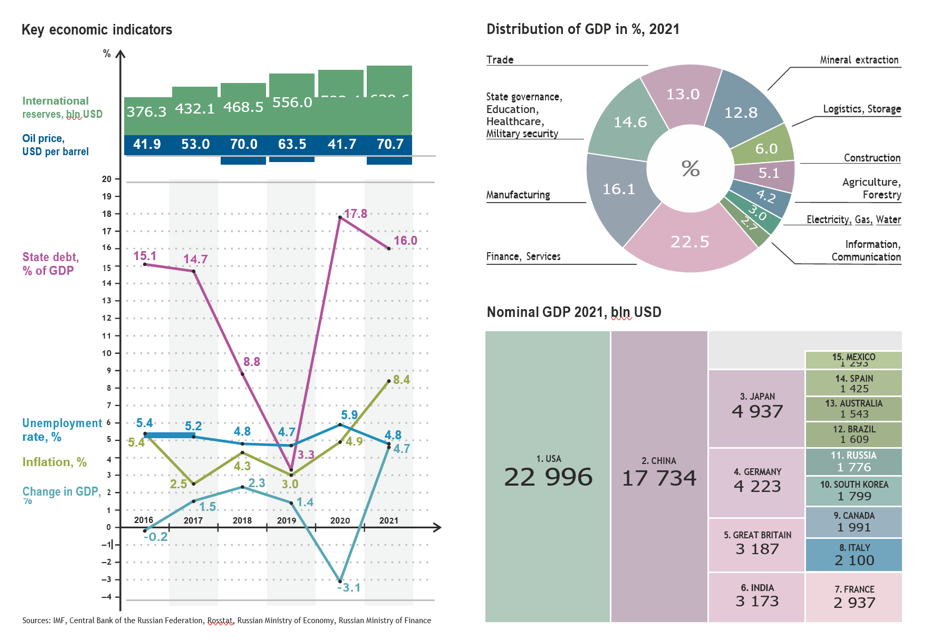
GDP (2021): 1 776 bln USD
GDP per capita (2021): 12 173 USD
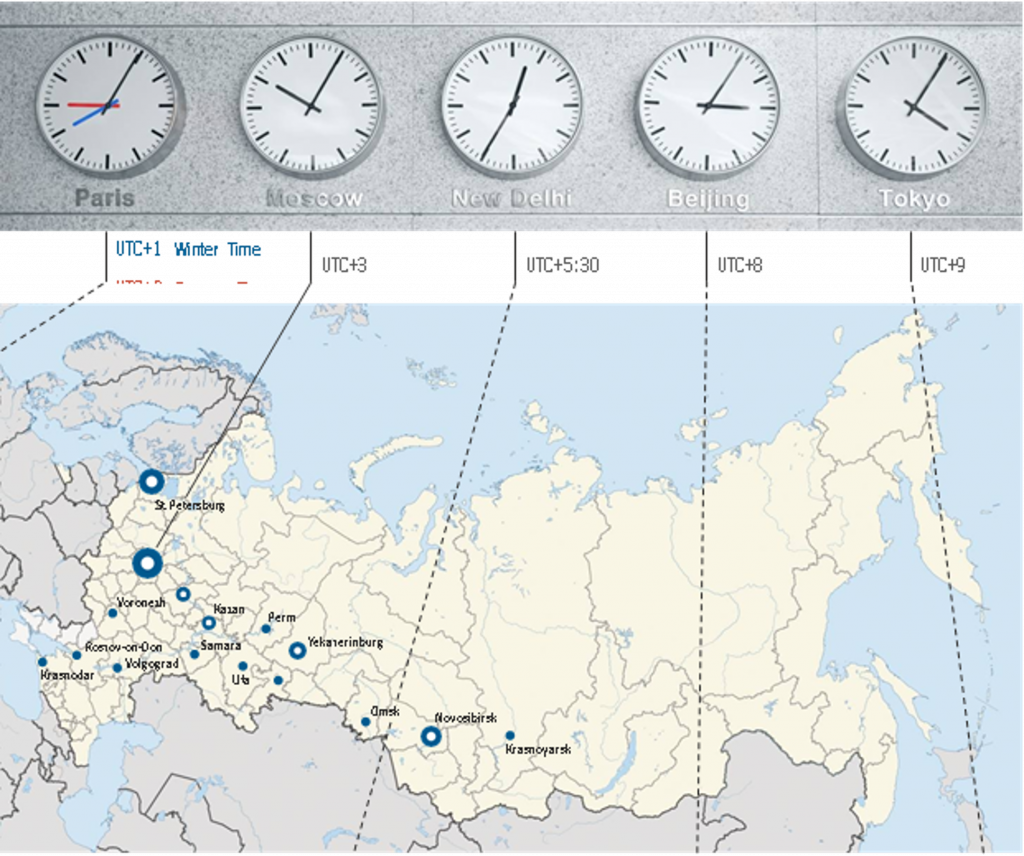
International restrictions have fueled a strategy of import substitution and production localization, particularly in the agribusiness, consumer goods, and pharmaceutical sectors.
Localization and import substitution are being encouraged by government programs, particularly special investment contracts and the development of technology parks and special economic zones.
Despite the disturbances that emerged in 2022, the prompt measures taken by the government, the accumulated reserves and stability on the labor market made it possible to avoid a sharp contraction of the Russian economy. According to forecasts of the RF Ministry of Economic Development, GDP reduction by the end of 2022 will not exceed 2.9%, while in 2024 it will begin to grow at an average annual rate of 2.6%, primarily due to the growth of domestic consumer and investment demand.
Forms of Business Presence in Russia
1. Companies which do not establish a permanent presence in Russia may conclude direct sales from a foreign company to Russian clients or sales through a Russian distributor.2. Companies which do establish a permanent presence in Russia may do so with a Representative Office, Branch, or Subsidiary.
Each option has various specifics to consider.
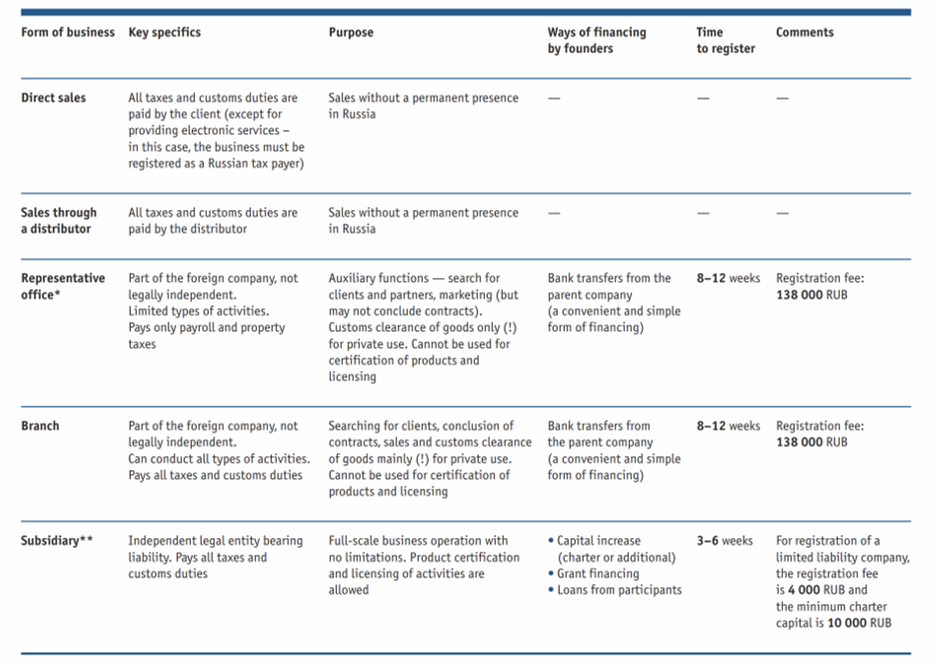
** To ensure smooth business operations in Russia (signing contracts, import of goods) it is recommended to establish a subsidiary company
Companies
- Limited liability company (LLC) — the most common form
- Joint-stock company (JSC)
- Public joint-stock company (PJSC) — the least popular, as additional requirements for information disclosure are imposed on PJSCs recommended to establish a subsidiary company.
Company registration
To register a company, one must prepare a standard package of documents, have it notarized and submit it to the Tax Office. Notarization may be carried out in Russia or another country; however, the personal presence of all founders of the future company is mandatory.
The registration procedure, including obtaining all necessary documents (company charter, foundation agreement, landlord’s approval, etc.) usually takes 3–6 weeks. This includes the one week that the Tax Office is given to make its decision. However, keep in mind that up to 15% of first-time registrations are denied.
Using the company's actual office / workspace as its legal address is recommended. In some cases, it is possible to register the company at the home address of the owner or General Director.
“Nominal” addresses bear a high risk of being denied registration, a bank account, and/ or the ability to participate in tenders. There is also the possibility of forced company liquidation and disqualification of its director for up to 3 years.
Company owners and General Director
Shareholder(s):
- May become personally liable for the company’s obligations, if these obligations arose due to the shareholders decisions or actions.
- A shareholders' agreement can be prepared, but its possibilities are limited by Russian legislation. In practice, shareholders' agreements are concluded in other jurisdictions.
- The company's debt to a shareholder may be converted into capital.
- A Russian legal entity may not be created by another legal entity if the latter has only one owner.
- In 2022, a special procedure was temporarily established for transactions with shares of Russian companies involving persons from the list of countries that have imposed sanctions on Russia — only with approval of the government commission for the control of foreign investment.
The level of liability of the General Director of a Russian legal entity is substantially higher than in case of a Western companyGeneral Director(s):
- Bears full responsibility for the activities of the company under labor, tax, customs and criminal law.
- The functions of the General Director can be performed by a management company. It is also allowed to appoint a Managing Company and a General Director at the same time, if this is stipulated in the Charter.
- Several General Directors may be appointed for one company (this is rarely done).
- To mitigate risks, the powers of the General Director may be limited by adapting the company's Charter.
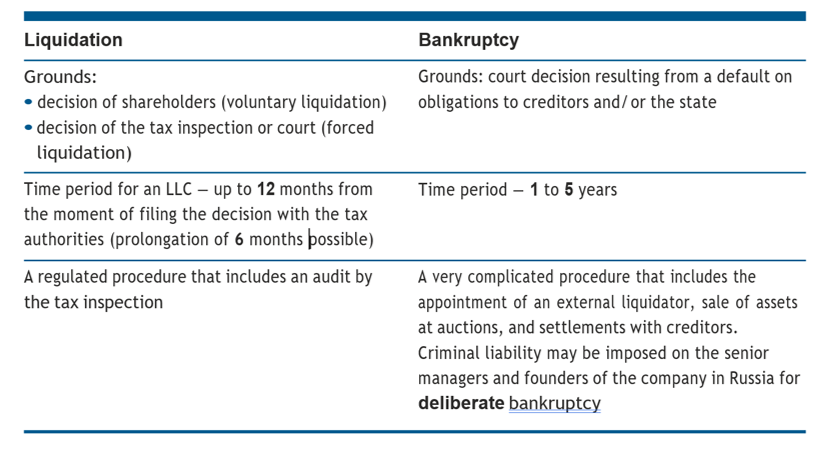
Company closure
Official closure of a company in Russia is a very lengthy and complicated process. Therefore, companies often cease their activities without closing the legal entity and continue filing “zero” reporting with the authorities.
The main forms of company closure are liquidation and bankruptcy.
The Russian-Asian Union of Industrialists and Entrepreneurs (RAUIE) has been helping foreign companies to develop business with Russia since 2010. To start cooperation with Russia with the support of the RAUIE you can leave an application via the "ask a question" form on the website, or by email office@raspp.ru.The article was prepared by experts from Bellerage, a member of the Russian-Asian Union of Industrialists and Entrepreneurs
Our experts will help you develop your business with Russia not only in export but also in import, namely to find a direct manufacturer in Russia and conclude a deal with him on the supply of products to China or start your investment project in Russia for the production of agricultural or food products for export to China, including obtaining government incentives for the investor in Russia.
.png "Пресс-центр")
.JPG "IMG_0978 (1).JPG")