


67 seaports, based in 5 sea basins, are located in Russia. Their largest cargo turnover is directed to the export of goods (79.1% in 2021); moreover, import (4.9%), transit (7.7%) and cabotage (8.3%) of cargo are carried out through the ports. The decline in the volume of international trading and economic recession, caused by the COVID-19 pandemic, affected the cargo turnover of Russian seaports in 2020, which decreased to 820.8 million tons (-2.4%). However, the container throughput turned out to be more resistant to "covid" realities and increased from 5.2 million TEU to 5.3 million TEU. In 2021, the container throughput of Russian ports continued to grow and amounted to 5.63 million TEU.
The Baltic Sea basin, specializing in the transshipment of oil and petroleum products, became the leader in container transportation in 2021. The container throughput amounted to 2.51 million TEU (+3.2% compared to 2020).
The Far Eastern basin, specializing in the export of fish, wood, food and the import of machinery and equipment, handled 2.12 million TEU (+10.9%) and was ranked the second.
The Azov-Black Sea basin, specializing in the transshipment of oil, petroleum products and seed, took the third place in terms of container throughput with an indicator of 844 thousand TEU (+6,4%).
The Arctic basin, handled 156,8 thousand TEU in 2021, was the only Russian basin that had a decline in container throughput compared to 2020 (-3.5%). In the structure of cargo transshipment of the Arctic basin ports, oil occupied almost a half of the volume, liquefied gas – a quarter.
The ports of the Caspian Sea basin, specializing in the transshipment of oil, petroleum products and seed, handled the smallest volume of containers among the basins of Russia (3.5 thousand TEU), but they had the highest growth rate of container throughput (+15%).
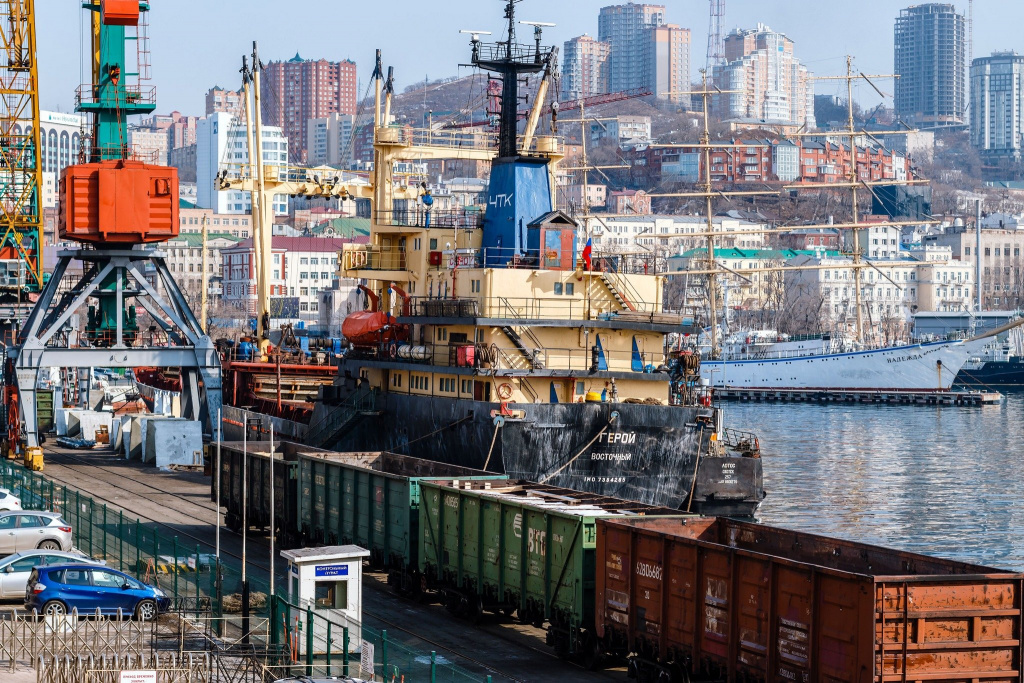
Container transshipment in Russia is based on large terminals that contribute to the development of the cargo transportation industry of the Russian Federation. Nevertheless, the geo-political situation of 2022 has a negative impact on the container throughput of Russian ports: terminals of the largest operators do not handle containers that should go to Russia or arrive from there (for instance, Maersk, MSC, CMA CGM), additional duties are imposed for the ship transit, navigation in the Azov-Black Sea basin is difficult. According to the Association of Commercial Sea Ports of the Russian Federation, for the period from January to April 2022, the container throughput of Russia amounted to 1.71 million TEU, which is 5.4% lower than the volume of the same period in 2021.
The ports of the Baltic Sea basin suffered the most: the container throughput decreased by 22.9% to 632 thousand TEU, the import declined by 28.4%. The container throughput of the Azov-Black Sea basin decreased by 5.1% to 298 thousand TEU. Nevertheless, in the Arctic basin, on the contrary, there was a significant increase in the container transshipment by 25.1% to 59.9 thousand TEU. The container throughput of the Far Eastern basin ports raised by 15.1%, amounted to 720.3 thousand TEU, that of the Caspian Sea basin – by 1.3% to 1 thousand TEU.
In January-April 2022, the ten largest Russian stevedoring companies handled 1.34 million TEU, or 78% of the total container throughput of the country.
1.The Vladivostok Commercial Sea Port
According to the data of the Association of Commercial Sea Ports of the Russian Federation, the Vladivostok Commercial Sea Port (port of Vladivostok) became the leader in the container throughput for the period from January to April 2022. The container throughput amounted to 245.55 thousand TEU, increased by 2.9% compared to the same period in 2021.
2. Vostochnaya Stevedoring Company
The container throughput of Vostochnaya Stevedoring Company (port of Vostochny) amounted to 184.51 thousand TEU. Increased the transshipment by 22.1%, Vostochnaya Stevedoring Company was ranked the second.
3. Container Terminal Saint-Petersburg
Container Terminal Saint-Petersburg (port of Saint-Petersburg) took the third place among all Russian terminals, despite the fact that it reduced the container throughput by 9.2% to 180.79 thousand TEU.
4. NUTEP Container Terminal
Handled 178.32 thousand TEU (-12%), NUTEP Container Terminal (port of Novorossiysk) was ranked the fourth.
5. First Container Terminal
First Container Terminal (port of Saint-Petersburg), taking the fifth place, dramatically reduced the container throughput by 20.8% to 165.69 thousand TEU.
Furthermore, the top 10 stevedoring companies of Russia for the period January-April 2022 included the Vladivostok Sea Fishing Port (port of Vladivostok) and the NLE port (port of Novorossiysk). Baltic Stevedoring Company (port of Kaliningrad) and Pacific Logistic Company (port of Vladivostok) took the 9th and 10th places, handled 56.86 thousand TEU (-41%) and 43.86 thousand TEU (+0.9%) respectively.
In conclusion, the seaports occupy one of the key places in the economy of the Russian regions and the country as a whole. Russia is adapting to the new realities, container throughput of several basins and ports is increasing, new container terminals are being built in the seaports, which makes the country a profitable partner in terms of international trade.
RAUIE has been helping foreign companies to conduct business with Russia for more than 12 years, as well as register companies, receive state support and permits, implement investment projects, obtain work permit and residence permits, purchase property and equip life.
You can apply for free consultation on business with Russia through the feedback form ("Ask a question") on the website or by e-mail office@raspp.ru
.png "Пресс-центр")
.JPG "IMG_0978 (1).JPG")
